

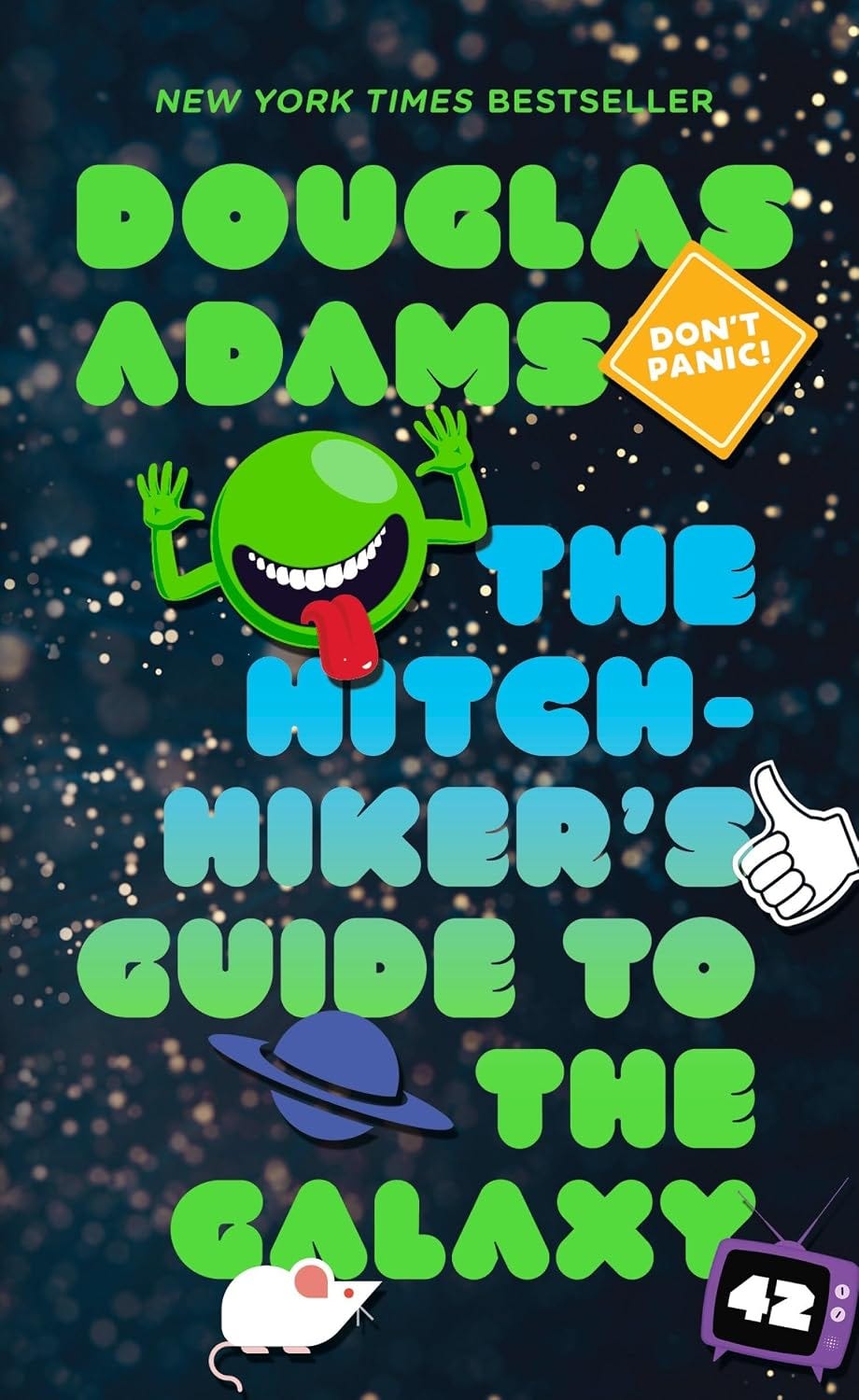
What Is The Point, Indeed
“You just let the machines get on with the adding up,” warned Majikthise, “and we’ll take care of the eternal verities, thank you very much. You want to check your legal position you do, mate. Under law the Quest for Ultimate Truth is quite clearly the inalienable prerogative of your working thinkers. Any bloody machine goes and actually finds it and we’re straight out of a job, aren’t we? I mean what’s the use of sitting up half the night arguing that there may or may not be a God if this machine only goes and gives you his bleeding phone number the next morning?”
Douglas Adams, The Hitchhiker’s Guide to the Galaxy: Volume One in the Trilogy of Five. London: Pan Books, 2016. p. 145.
Great Ideas: Man, Wisdom, God, Knowledge
The first time a read this book, generative A.I. was not the perpetual topic of discussion that it is today. But when I gave it another read this Summer, I saw several points where A.I. could easily be considered as part of the joke. Here, I thought it most humorous because Adams seems to be skewering both sides of a debate that didn’t even exist when he wrote it. But he does seem to have a knack for caricaturing both sides in the current moment. What I find most interesting here is that Majikthise thinks the machine might actually find God, which is not why I see most anti-A.I. folks raising objections.
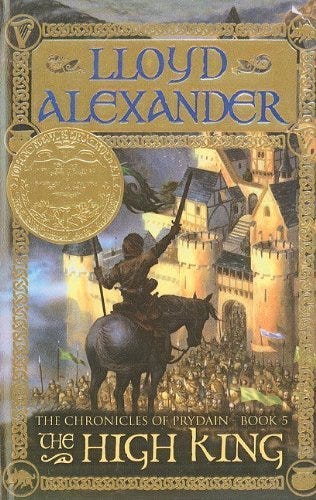
What If Memory Is Lost?
“Memory lives longer than what it remembers,” Taliesin said. “And all men share the memories and wisdom of all others. Below this chamber lie even richer troves.” He smiled. “Like poetry itself, the greater part is the more deeply hidden.”
Lloyd Alexander, The High King (The Chronicles of Prydain, Book #5). New York: Bantam Doubleday Dell Books, 1990. p. 140.
Great ideas: Poetry, Memory & Imagination, Wealth, Monarchy
I read this with my third son, though it had been so long since I’d read the series that much of it lingered in a fog of memory. Still, the book moved me near tears on multiple occasions, which I think is a testimony to the strength of Alexander’s storytelling. I actually bought these for my boys on the recommendation of H. W. Taylor and I have been glad to have them. They are themselves rich, seemingly embodying the wisdom of Taliesin here. If you have not yet dove into the world of Prydain, I cannot recommend it enough.
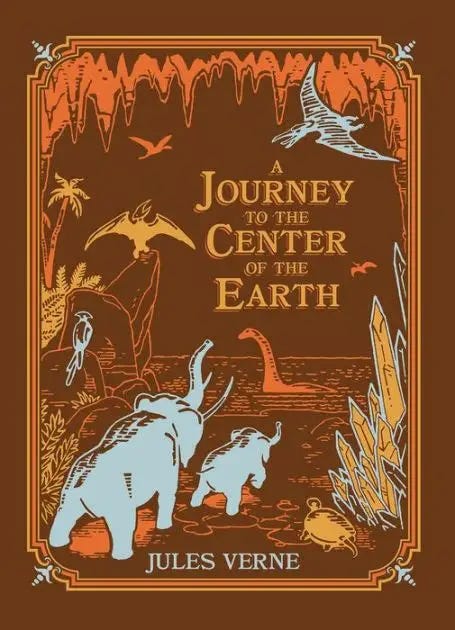
Farmers Who Can Read
In this old island of ice, we are fond of study! There’s not a farmer or a fisherman who cannot read and doesn’t read. We are of opinion that instead of letting books grow moldy behind an iron grating, far from the vulgar gaze, it is better to let them wear out by being read.
Jules Verne, A Journey to the Center of the Earth. Translated by Frederick Amadeus Malleson. Edited by Ursula K. Heise. New York: Barnes and Noble Classics, 2005. p. 55.
Great Ideas: Knowledge, Education, Dialectic, Citizen
I like to keep a classic work of fiction going in addition to whatever else I’m reading, if for no other reason than they are often such fun to read. I’ve read little of Verne, and given my great affection for Edgar Rice Burroughs, Journey seemed the most logical place to go. There is little doubt that Verne is a master of backstory. Much like Around the World in 80 Days, he spends a rather large amount of time building characters before the adventure even gets underway (Burroughs, by contrast, often threw his protagonist into the adventure and let the backstory fill in over time, if at all). I’m enjoying it quite a bit and I’m making lots of notes for future work as I go.
The Fortunate Writer
Things may not be immediately discernible in what a man writes, and in this sometimes he is fortunate; but eventually they are quite clear and by these and the degree of alchemy that he possesses he will endure or be forgotten. Writing, at its best, is a lonely life.
Ernest Hemingway, “Banquet Speech,” in Nobel Lectures, Literature 1901-1967. Edited by Horst Frenz. Amsterdam: Elsevier Publishing Company, 1969. p. 501.
Great Ideas: Poetry, Form, Memory & Imagination, Time
This Summer has been, well, insanely busy. As a result, I’m way behind on my reading schedule. This is an older commonplace that I often return to when I’m thinking about what makes a writer great. Hemingway goes on to say more about the writing life here, but the immediate juxtaposition of the writing life about being remembered and also as a lonely vocation strike me as worth pondering further. There is often a tension for great artists who desire fame (or to leave a legacy) and the kind of social lives they lead. Hemingway was sometimes a perfect example of this, though he often could demonstrate how this tension wasn’t always a necessity.
Good Medicine Is Often Difficult
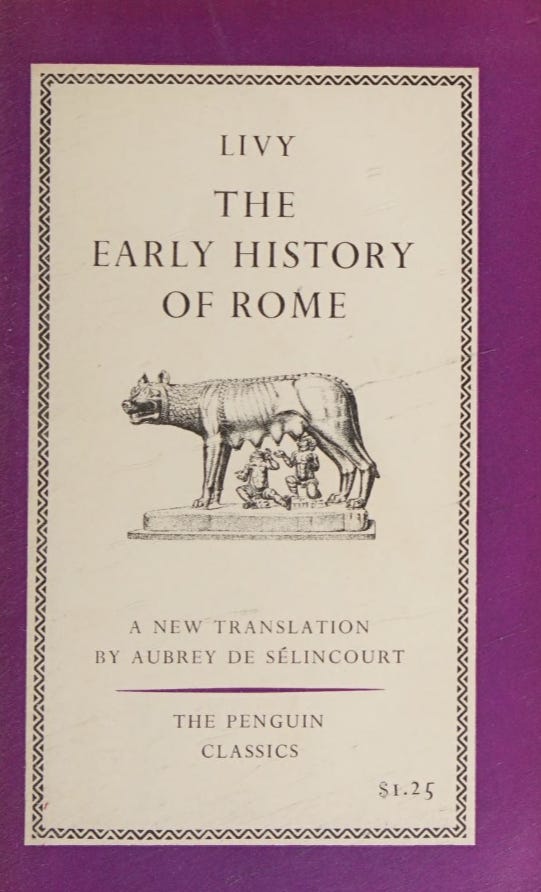
The study of history is the best medicine for a sick mind; for in history you have a record of the infinite variety of human experience plainly set out for all to see: and in that record you can find for yourself and your country both examples and warnings: fine things to take as models, base things, rotten through and through, to avoid.
Livy, The Early History of Rome, Books I-V. Translated by Aubrey de Sélincourt. Baltimore, MD: Penguin Books, 1960. 1.1 [p. 13].
Great Ideas: History, Life & Death, Custom & Convention, Sin
This is another oldie, but also a goodie. When I taught Livy for the first, this little thesis slapped me in the face in a way that few pieces of writing ever have. I cannot count the number of times I’ve returned to this in my own writing, in my research, in my teaching, and even just in my own meandering thoughts. Livy hits on a fundamental truth here that I don’t think can be overemphasized. And there are certainly a lot of folks who are online way too much who could do to better understand what Livy’s talking about here.