

Nations, Virtues, & More
Commonplaces Vol. 14 - July 2026
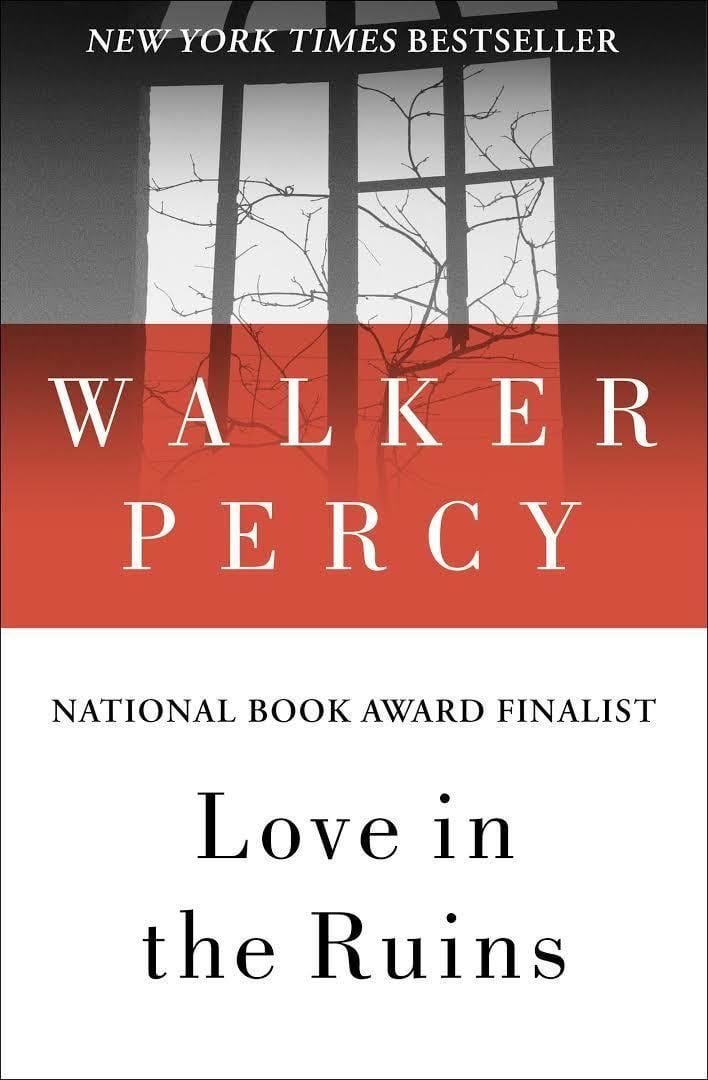
A Nation of Rowdies
They were a pair of rascals. What a surprise. No one ever expects the English to be rascals (compare Greeks, Turks, Lebanese, Chinese). No, the English, who have no use for God, are the most decent people on earth. Why? Because they got rid of God. They got rid of God two hundred years ago and became extraordinarily decent to prove they didn’t need him. Compare Merrie England of the fifteenth and sixteenth centuries. A nation of rowdies.
Walker Percy, Love in the Ruins. New York: Picador, 1999. p. 226.
Great Ideas: Citizen, World, God, Constitution
Working on my dissertation, I wrestled a lot with the distinction between poet and prophet. The words have a tangled history, which I might write about here someday. There are not many modern authors to whom I might consider the label prophet appropriate, but Walker Percy is certainly one of them. This line could have been something written only in the last few weeks, watching the English government seemingly suggest to her citizens that they are not worth preserving. The speaker, here, Dr. Tom More, is not always a reliable voice. But here, I think his criticism might ring louder today than it did in the 1970s. May the good Lord revive the “nation of rowdies” that once made England the land of Chaucer, Spenser, Shakespeare, and Milton.
Bringing Healing
So many knights just draw their swords
to shed blood on the land.
They lust for might and mastery,
they only prate of courtesy,
and keep a code of chivalry
they scarcely understand.But when the sword of destiny
is holden in your hand,
then you will not bring violence
but healing on the land.
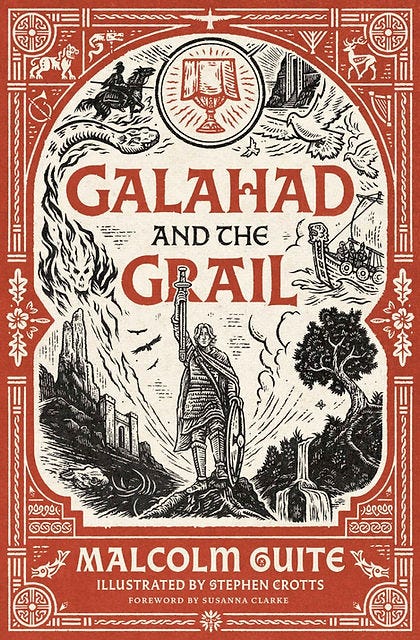
Malcolm Guite, Galahad and the Grail, Nashville, TN: Rabbit Room Press, 2026. 1.1.109-118 [p. 12].
Great ideas: Fate, Duty, Pain & Pleasure, Custom & Convention
Speaking of the English, I am quite enjoying Guite’s first part to his Arthurian epic. It strikes me as the kind of thing that might indeed renew the appropriately “rowdie” nature of the English people, from whom Galahad springs. Guite’s poetry simply flows; I can envision many classical schools adopting these texts in the near future (though I’m not yet sure if this will be the right thing). I hope to meet Guite one day, but until then, I shall enjoy his marvelous expansion of the legend of Arthur.
Discovering Virtues
Nikolay Vsyevolodovitch’s respectfulness to his mother was enlarged upon. Various virtues were discovered in him. People talked with approbation of the learning he had acquired in the four years he had spent in German universities.
Fyodor Dostoevsky, The Possessed. Translated by Constance Garnett. New York: Barnes and Noble Classics, 2005. p. 297-298.
Great Ideas: Virtue & Vice, Education, Mind, Experience
I’ve been committed to the Pevear translations of Dostoevsky for a long time now. I have read of their shortcomings many times, but I know next to nothing about Russian and have found so much good in the Pevear translations that I see no reason to trash them. Still, so many of the authors I study (i.e. Hemingway, Sylvester) read the Garnett translations and referenced them in their own work. So, when the opportunity arose to read The Possessed (or The Demons depending on your translator), I decided to go with Garnett’s translation. It has been a wild ride thus far, and I can see why people call it his most overtly political novel. At least, it seems true of the one’s I’ve read. I hope to have more to say on this one in the future.
The Existence of Virtue
But is not enough to possess virtue, as if it were an art of some sort, unless you make use of it. Though it is true that an art, even if you never use it can still remain in your possession by the very fact of your knowledge of it, yet the existence of virtue depends entirely upon its use.
Cicero, The Republic, in De Re Publica & De Legibus. Translated by Clinton Walker Keyes. Vol. 16. Cambridge, MA: Harvard University Press, 1970. I.i.1-2 [p. 15].
Great Ideas: Virtue & Vice, Art, Experience, Quality
Last week, I was in Tallahassee for a teacher training event at FSU’s Institute for Governance and Civics. The sessions I led were my own attempt to demonstrate how to discuss The Declaration of Independence, through the use of Cicero’s two works which exerted the most direct influence. What should not surprise anyone is how essential the virtues are to Cicero’s conception of the State and the Citizen. This is one of my favorite lives from his Republic, particularly because of his argument delineating between art and action. I think an inverse argument might likewise hold true.
A Likeness Between Man and God
Virtue exists in man and God alike, but in no other creature besides; virtue, however, is nothing else than Nature perfected and developed to its highest point; therefor there is a likeness between man and God. As this is true, what relationship could be closer or clearer than this?
Cicero, The Laws, in De Re Publica & De Legibus. Translated by Clinton Walker Keyes. Vol. 16. Cambridge, MA: Harvard University Press, 1970. I.viii.24-25 [p. 325].
Great Ideas: Virtue & Vice, God, Nature, Relation
Even though these are technically in the same bound volume, they’re fundamentally two separate books. Here, Cicero’s invocation of man’s relationship to God is important for the way society functions, and also for the way individuals understand where they stand in life. I can see why Dante had such high praise for Cicero in Canto 4 of The Inferno. He may have been a pagan, dead before our Lord was incarnate, but he seems to me more and more to be the best of what the pagan world had to offer.