

Experience & Literature
Commonplaces Vol. 13 - June 2026
To Learn and Mark
Let him who fails to learn and mark
Three thousand years still stay,
Void of experience, in the dark,
And live from day to day.
Johann Wolfgang von Goethe, “Rendsch Nameh: The Book of Ill Humours, Poem XV, Stanza 4” in West-Eastern Divan, in Twelve Books. Translated by Edward Dowden. London: J. M. Dent & Sons, 1914. p. 74-75.
Great Ideas: Experience, Custom & Convention, Wisdom, Time
I have not read a lot of Goethe, though he continually sits amongst my “To Read” pile. I saw a different translation of this passage making its way across Substack Notes, which prompted me to do some digging. It struck me as too convenient of a quote and I’m naturally skeptical of quotes circulating the internet without sources. In this case, the quote turned out to be genuine, though I couldn’t find the exact translation. This led me to a research-rabbit trail, learning some things about Goethe that I did not know. I read a big chunk of West-Eastern Divan as well, though this is the section that still captivated me.
The Unfairness of It All
Ransom was sitting with his fingers locked so tightly that his knuckles were white. The unfairness of it all was wounding him like barbed wire. Unfair . . . unfair. How could Maleldil expect him to fight against this, to fight with every weapon taken from him, forbidden to lie and yet brought to places where truth seemed fatal? It was unfair!
C. S. Lewis, Perelandra, New York: HarperCollins, 2012. p. 127.
Great ideas: Justice, Rhetoric, Logic, Truth
Even though I finished this one recently, I’m reading it again because the book club I’m in selected it for June. I had not noticed previously how well Lewis sets up the final confrontation between Ransom and the Unman from as early as the first chapter of the book. There is a constant focus on Ransom’s strengths from the outset, which turn out to be of no avail to him in the end. Lewis’s skill as a fiction writer is really underappreciated, I think. Though Till We Have Faces did make Joel J Miller’s recent list of the best novels, so there’s always hope for a proper reassessment.
The Canonization of Scientists
If the truth be known, scientists are neither more nor less vain than other people. It is rather that their vanity is the more striking as it appears side by side with their well-known objectivity. The layman is scandalized, but the scandal is not so much the fault of the scientist as it is the layman’s canonization of scientists, which the latter never asked for.
Walker Percy, Love in the Ruins. New York: Picador, 1999. p. 13.
Great Ideas: Virtues & Vices, Science, Hypothesis, Same & Other
It has been a few years since I last read Love in the Ruins, but it still proving just as hilarious. I’m going through it as a Summer Slow Read with some other Percy readers and I find this a refreshing practice every year. One of the things about Percy which always strikes me is just how prescient he seems. If Love in the Ruins is speculative fiction, it is one of those which seems to anticipate what is to come with almost prophetic force. The many reflections on science and scientists in the novel were true when Percy wrote them, but they have accelerated and grown far beyond what he describes.
The Thousand External Circumstances
A national literature, in the widest signification of the words, embraces every mental effort made by the inhabitants of a country, through the medium of the press. Every book written by a citizen of a country belongs to its national literature. But the term has also a more peculiar and appropriate definition: for when we say that the literature of a country is national, we mean that it bears upon it the stamp of national character. We refer to those distinguishing features which literature receives from the spirit of a nation, from its scenery and climate, its historic recollections, its government, its various institutions, from all those national peculiarities which are the result of no positive institutions; and, in a word, from the thousand external circumstances which either directly or indirectly exert an influence upon the literature of a nation, and give it a marked and individual character, distinct from that of the literature of other nations.
Henry Wadsworth Longfellow, Outre-Mer: A Pilgrimage Beyond the Sea, in The Prose Works of Henry Wadsworth Longfellow: Outre-Mer, Hyperion, Kavanagh, The Poets and Poetry of Europe, Essays, Etc. London: Chatto and Windus Publishers, 1874. p. 202.
Great Ideas: Citizenship, Poetry, One & Money, Soul
Finding a good copy of Outre-Mer is incredibly difficult. Part of the problems lies with Longfellow; he edited the published edition more than once, removing chapters or putting them back in without explanations or clarifications of “editions.” Add to that the poor sales of the first edition, and the wide reprinting of Longfellow’s works when his popularity was at its zenith, and it becomes a detective’s job just trying to find the best edition of the book. The chapter I’ve quoted here is fascinating, and it is different from the essay he would write previously, “The Literary Spirit of Our Country” (the latter from 1824 and the former from 1835). I would love to work on something deeper here, exploring how Longfellow’s views changed over time. But that will have to wait a while.
God’s Grandchild
“Philosophy,” he said, “to him who heeds it,
Noteth, not only in one place alone,
After what manner Nature takes her courseFrom Intellect Divine, and from its art;
And if thy Physics carefully thou notest,
After not many pages shalt thou find,That this your art as far as possible
Follows, as the disciple doth the master;
So that your art is, as it were, God’s grandchild.”
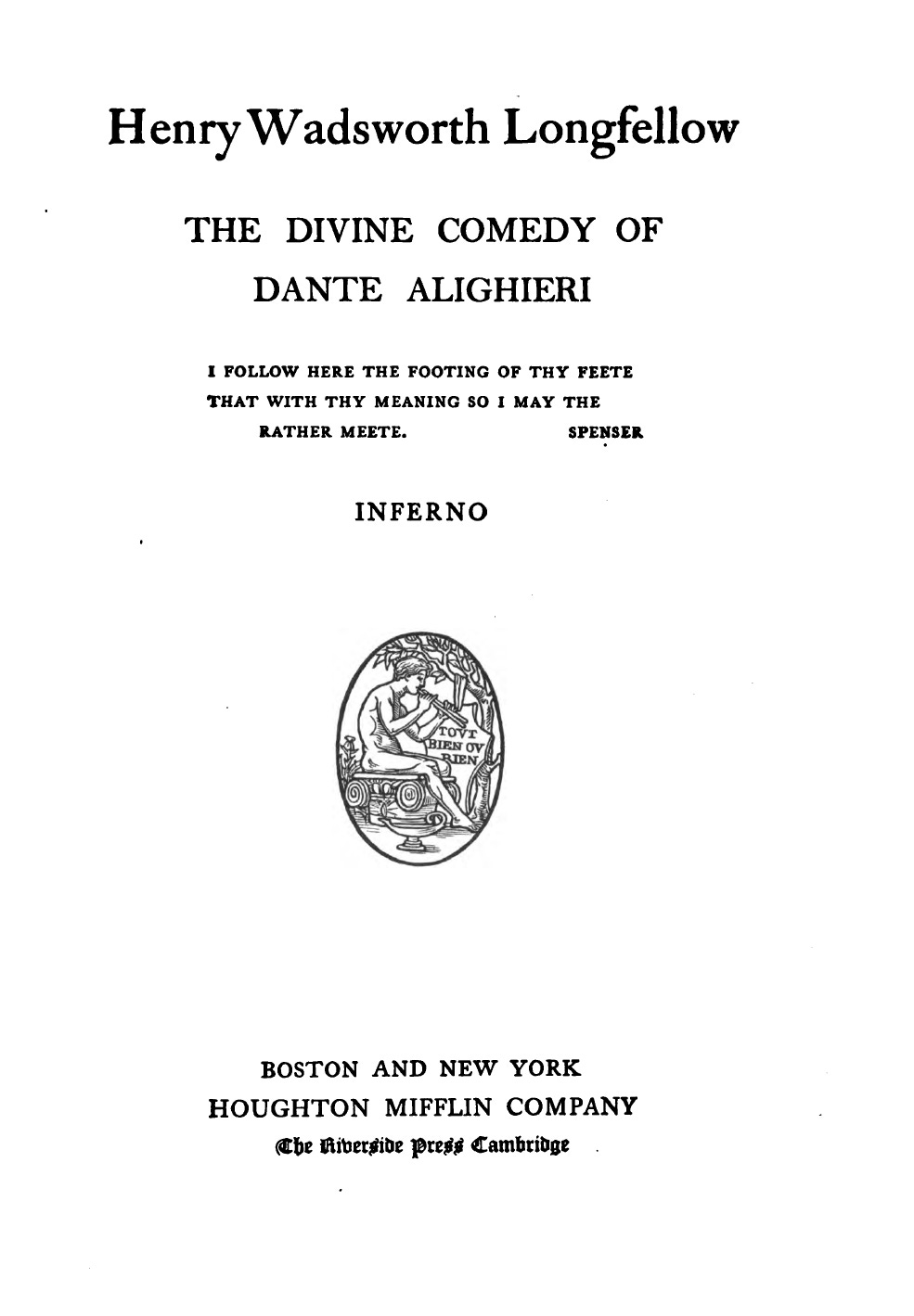
Dante Aligheri, Inferno in The Divine Comedy. Translated by Henry Wadsworth Longfellow. The Complete Writings of Henry Wadsworth Longfellow, Vol. 9. Boston: Houghton Mifflin Company, 1914. Canto 11, lines 97-105 [p. 75].
Great Ideas: Philosophy, Nature, Physics, God
I concluded my final course for Thales College’s CCEP Program last week and discussed Dante’s Inferno with the students.1 I’ve started using Columbia’s Digital Dante for these online discussions because I can easily look at Mandelbaum’s translation alongside Longfellow’s. I understand that it is worthwhile to read more modern translations of Dante, but Longfellow’s has a special place in my memory. And this reflection stood out to me on my most recent pass through. He may not be where people start reading The Divine Comedy anymore, but I still recommend giving it a try at some point.
The good news is that with the launch of the Logres Institute, students can continue to read Dante with me in the Great Books Certificate program.