

A Bit Far from the Inferno
Four Views on Hell: A Review

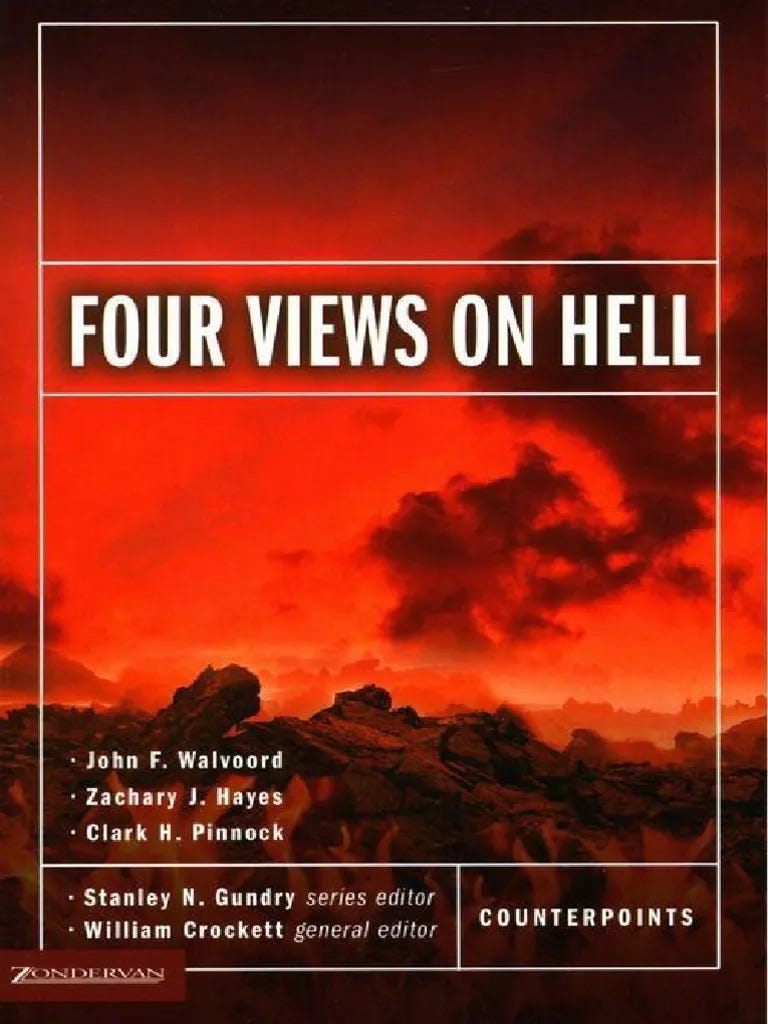
John F. Walvoord, Zachary J. Hayes, Clark H. Pinnock, and William Crockett. Four Views on Hell. Edited by Stanley N. Gundry. Grand Rapids, Michigan: Zondervan, 1996.
The book, Four Views on Hell, is part of a series from Zondervan publishing entitled “Counterpoints.” The book, co-written by authors with very different backgrounds and views concerning the Christian doctrine of Hell, stands out as a simple and concise introduction to the debate that has surrounded one of the most controversial aspects of Christianity for centuries. The authors each present their own perspective on the doctrine of Hell, and then the other contributors are each given a short chapter to counter each other. The book treats each author with respect and gives them ample space to defend their position. This balanced work implements a unique form and provides a good starting point for Christians seeking to learn more about the theology that surrounds the debate.
Four Views on Hell is broken into four main parts. Each author takes on a chapter and attempts to present the best case they can for their particular view on Hell. Since the book is meant to serve as a beginning introduction or discussion of the doctrine of Hell, only four of the more common ideas are addressed. The views are summarized as Literal, Metaphorical, Purgatorial, or Conditional. After each author has sufficiently presented his material, the other three authors are given a short space to respond in kind, and shed light on what are seen as flaws in the argument being presented.
The Literal View, addressed by John F. Walvoord, tackles the issue head on. Relying heavily on the Old Testament and the teachings of Jesus, Walvoord presents a case that sees the descriptions of Hell as something to be taken at face value. He acknowledges that the Bible does not completely explain the nature of Hell, but he ultimately concludes that there is enough evidence in the Bible to take the fires of Hell to be a physical description. The Metaphorical View is taken on by Williams V. Crockett, and utilizes the writings of other Christians to help explain why Hell should be taken with a grain of salt. Citing Jewish apocalyptic literature at one point, Crockett highlights the use of figurative language throughout literature. Crockett asserts that while Heaven and Hell are very real places, the descriptions used in the Bible should be understood in the context of when they were originally written. Diving head on into the Purgatorial View is Zachary J. Hayes. Hayes emphasizes the role of how one “approaches the Bible and understands revelation” in believing in Purgatory (101). Centered on the idea that some will be redeemed after death through a purging process, the Purgatorial View is “seen as a symbol of the full maturation of a person’s decisive choice for God” (118). The Conditional View, explained by Clark H. Pinnock, attempts to break down the dividing wall between those who cannot bring themselves to believe that a loving God would eternally punish the wicked. Pinnock digs deep into the recesses of pop culture and academia to support his perspective, and he concludes that the traditional views of Hell are “detrimental to the character of God” (465). He divides his view into universalism, where everyone eventually goes to heaven, and annihilationism, where the wicked are done away with permanently. Annihilationism, he claims, is the more Biblical of the two choices.
G. K. Chesterton once wrote, “whenever we feel there is something odd in Christian theology, we shall generally find there is something odd in the truth.”1 This idea has much to do with the purpose behind Four Views on Hell. There are lots of books on Christian theology, and a startling number of them focus on the afterlife. Where our souls or spirits will go after we die permeates many cultures, being a chief dissenting point between religions and often becoming the joke or plot twist of many Hollywood productions. Four Views on Hell is an attempt to dispel some of the mystery that causes people confusion regarding Christian beliefs. This is undoubtedly the best way to approach the subject, as any attempt to harmonize the various views on Hell would result in bickering and arguments about “being compromised.” But still, the notion of Hell alternates between a bane and a motivating point for many Christians and prospective converts. As pointed out in the Foreword to the book, a day of judgment is coming, and God will not be pleased with the disobedient (7).
N. T. Wright has devoted much of his recent work towards reshaping the way Christians approach the concepts of Heaven and Hell. Seeing that both destinations hinge upon the idea of redemption, Wright spends a considerable amount of time examining how this plays out in our daily lives. He writes,
Redemption is not simply making creation a bit better . . . Nor is it rescuing souls from an evil material world . . . It is the remaking of creation, having dealt with the evil that is defacing and distorting it. And it is accomplished by the same God, now known Jesus Christ, through whom it was made in the first place . . . What creation needs is neither abandonment nor evolution but rather redemption and renewal; and this is both promised and guaranteed by the resurrection of Jesus from the dead. This is what the world has been waiting for.2
The point is this: how one thinks of what comes after this life affects the way one lives. With that concept in mind, Four Views on Hell is a thorough and simple book which puts people on the path to figuring out what exactly they believe.
Of the chapters presented, the Literal View offered by Walvoord is the most Scripturally based. While it is important to remember that the Biblical references to Hell are not the point (God is always the point), the collection of verses and historical studies done by Walvoord present a convincing argument. Other than the “moral argument” presented by Pinnock, the other authors have a challenging time finding grounds to dismiss Walvoord’s claims (38). Even in disagreement, the other authors cannot seem to muster a strong rebuttal against Walvoord, opting instead either to relegate his opinion to the realm of irrelevancy or to say they agree with him only in part (31, 35-36).
While the rest of the chapters are thought-provoking and well-written, they do not possess the same tenacity and use of Scripture as Walvoord. The Metaphorical and Purgatorial Views are presented well, but their reliance upon works outside of Scripture, and particularly outside the Christian tradition, seem to indicate a need to avoid what the Bible does say regarding the doctrine of Hell. Crockett’s attempts to put focus on a Hellenistic influence away from the Metaphorical View is interesting but difficult to validate (67-68). There were many views applying pressure to early Christians, yet these other influences are hardly referenced during Crockett’s discussion. His focus on one source of change hinders his argument, even if he is right.
Hays’ explanation suffers from his own admission that what he defends is highly subject to individual interpretation (118). Millard Erickson points out, in his Christian Theology, that the primary source for the Catholic doctrine of Purgatory comes from the Apocrypha, which is in and of itself something that divides Catholics and Protestants.3
The final view examined, the Conditional View, has gained the most traction in recent years. Many scholars echo Pinnock’s idea that a place of eternal punishment simply serves no purpose and is contrary to the good news of Jesus Christ (153). The other authors do a good job of illustrating how the “moral argument” against Hell is not something easily dealt with, but still they present a convincing case that the universalism and annihilationism that so often accompany the Conditional View stem from places outside of Scripture (like Hans Kung), and find little support within the Biblical text itself.
While not a strict literalist myself, I firmly felt that in the format provided, Walvoord’s perspective was the most thorough and convincing.4 Given that this form of discussion (a book in which authors must correspond with and be critiqued by their peers) lends itself to one’s ability to best present physical evidence, it is easier for Walvoord to begin with. In a different setting, perhaps a different perspective would have better ground to stand on.
Four Views on Hell fulfills its function of opening dialogue and making a hotly debated issue accessible to people outside of the academic circuit. The book is well written, and even in the moments where the various authors disagree, they maintain a level of civility and respect that is not often seen in the debates and forums where these kinds of things usually take place. The sections of rebuttal could stand to be lengthened, as I often felt that the other authors were cut short in their discussions, but the brevity of the book does help it succeed in its goal of accessibility in the end. This is a book that I would recommend to Christians struggling with the concept of Hell, and even non-Christians who cannot see how a loving God could create a place “like Hell.” There are few who would not benefit from being able to see how Christians can be diverse, and yet unified, as this book does a wonderful job of illustrating.
Chesterton, Orthodoxy, New York: Doubleday, 1990, p. 74
N. T. Wright, Surprised by Hope: Rethinking Heaven, the Resurrection, and the Mission of the Church. New York, New York: HarperOne, 2008, pp. 97, 107.
Millard J. Erickson, Christian Theology. 2nd. Grand Rapids, Michigan: Baker Academic, 1998, pp. 1186.
By this I merely mean that I don’t take the imagistic language to always be a literal, physical description. It very well might be such, but I see no reason it might not be an attempt to explain something metaphysical using physical language. I am a strict literalist in the sense that I agree with Walvoord that Hell must be real, surely aligns with the general sense given in Scripture, and fits into God’s divine justice.
Does Hayes defend the view that "some will be redeemed after death through a purging process" in Purgatory? That's not the traditional view of Purgatory. Everyone there is redeemed, just not cleansed of their sins.