

Learning the Long Way
The First Book Review I Ever Wrote

This is the first book review I ever wrote, all the way back in 2010. It has been slightly amended to reflect further thought (and rereading). But my initial praise for Hall’s book still stands, I think. I’m toying with including older, revisited works like this as part of the regular publications.
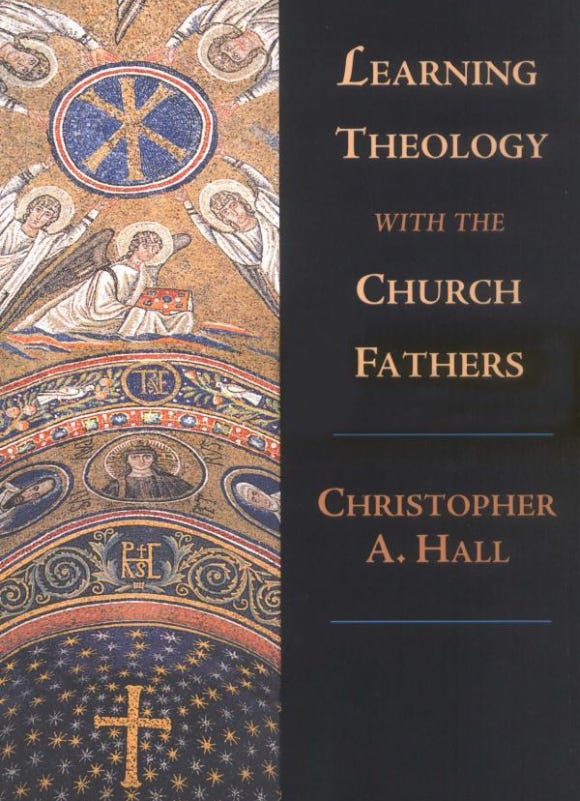
Learning Theology with the Church Fathers by Christopher A. Hall Downers Grove, Ill: Intervarsity Press, 2002, 308 pp, $18.00 paperback.
Christopher A. Hall, an associate editor of the Ancient Christian Commentary on Scripture, and provost of Eastern University as well as dean at its Templeton Honors College, delves into the world of early Church Fathers to write an understandable synopsis of the ideas prevalent in the earlier points in Church history. His book, Learning Theology with the Church Fathers, is a smoothly written treatise on the unity of belief throughout the corporate Church. Beginning with some of the most controversial theological concepts that causing tension in the earlier Church, Hall attempts to illustrate the connecting ideas that have stretched across the epochs of the history of Bride of Christ and demonstrate how these ideas are accessible to all Christians despite feelings of fear due the perceived complexity of theological endeavors. According to the Bibliotheca Sacra, Hall’s book is “a much needed corrective to Protestant ignorance and suspicion of tradition, combating the claim that somehow being traditionless is achievable and advantageous.” While not as forceful or aggressive in the book, Hall’s underlying mission throughout is to illustrate that Protestant beliefs are indeed united with the broader (o)rthodox and (c)atholic Church.
Considering the difficult topics tackled by Learning Theology with the Church Fathers, the book is written in a simplistic manner that breaks arguments down by topic. Instead of approaching individual Church Fathers and attempting to explain their contributions to Christian belief, Hall weaves a progression of faith (following the Nicene Creed for the most part) that begins with the Incarnation of Jesus Christ and culminates with the bodily resurrection of the dead in Christ. As the second book in Hall’s trilogy on the Church Fathers, he lays his goal out clearly in his preface: “This volume, like its predecessor, is simply designed to be a primer for beginners” (12). Of course, as the book progresses, the underlying message of a united faith becomes clearer, and the journey to that message is not quickly completed. Hall encourages his readers to, “read slowly, listen carefully, and surround the entire process with prayer,” and his advice should not be ignored (13). While well worded, the concepts being discussed on the pages before the reader are truly lofty ones. At times, the average reader may need to stop and take a deep breath before plunging back in.
Each chapter begins with quotes relevant to the particular topic, followed by a brief summary of the argument at hand. The summaries may often be off putting, but every reader should rest assured that sticking out the background information is well worth the payoff once Hall begins to elaborate on the Church Fathers writings and thoughts. Hall presents both sides of every issue, starting with the one ultimately decided to be heterodox, and ending the chapter with the view that is considered orthodox. Peppered heavily with quotes and references, readers will find Hall’s index at the end of the book incredibly helpful for some elaboration and outside sources, although the index might have served more use coming at the end of each chapter. The flow of the book works well with the topic, as the Nicene Creed provided a nice outline for the topics covered.
Hall’s greatest strength lies in his ability to summarize the writings of Ancient authors in a lively manner. While there are certainly excellent translations out of the works of Tertullian, Cyprian, Augustine, Origen, and the like (i.e. Philip Schaff’s many translations available through the Christian Classics Ethereal Library online), a translation can still be incredibly cumbersome for those who are not aspiring to theological professorships. As Hall wrote in his preface, this book is designed to explain some of the most foundational Christian doctrines in a way that welcomes beginning learners yet at the same time does not alienate the scholar either. Hall accomplishes this brilliantly throughout the book, perhaps best in the third chapter, “The Mystery and Wonder of the Trinity.” Demonstrating his ability to intertwine the writings of the Church Fathers with his modern style, he pens:
Augustine’s final conclusion? If within the creates order, indeed, within humanity itself, we have instances of realities both separate and inseparable, we should ‘believe that the Father, Son, and Holy Spirit may be exhibited separately, by certain visible symbols, by certain forms borrowed from the creatures, and still in their operations be inseparable. (80)
This example demonstrates Halls prodigious tapestry of modern and ancient writing, which is the primary reason that his work reaches out to so many readers on such differing levels of thought.1
It is clear throughout that Hall identifies foundational doctrine with the Orthodox Church (including Catholic, Anglican, etc.). Many of the debated points (like Augustine’s endorsement of infant baptisms) continue to flummox Protestant churches. But Hall’s explanation of Church beliefs through the writings of the Patristic writers is superbly handled and would be a great benefit to any reader wishing to know more about the development of Christian theology, regardless of where one might fall on the Orthodox-Catholic-Protestant spectrum.
Other readers may find different chapters inspiring, which is part of the charm of Hall’s work, but for this reader, his chapter on the Trinity was far and above the best. Hall’s treatment of Augustine’s work was, for the first time, relatable and completely comprehendible. I am forever indebted to the author for his time spent on this subject.