

Inside You There are Four Wolves
Wherein I Boldly Make Undefended Claims (A Knickerbocker Education No. 1)

One of the things I hope to accomplish this year is a bit more writing specifically related to Classical Education. I knew two years ago that if I shifted this space to focus on CE, I’d probably grow my audience. But growth isn’t really my goal here; I want a place where I can write about things that interest me and Substack has served that end. On the other hand, I’ve noticed that I benefit from having specific targets as well. My aim going forward is to write one piece per month specifically about Classical Education. Pedagogy, philosophy, and hot takes will abound. And this first post in my “A Knickerbocker Education” series is in that latter category.
I want to offer four brief thoughts on things for Classical Education enthusiasts to consider in 2026. These are things that could be of interest to more than just the classroom teacher; administrators, homeschool parents, students, researchers, and brick & mortar parents might find each of these claims piques their interest at different levels. But these are all things which I anticipate will grow in significance this year.
1. Curriculum arguments will take on a decidedly Political tone.
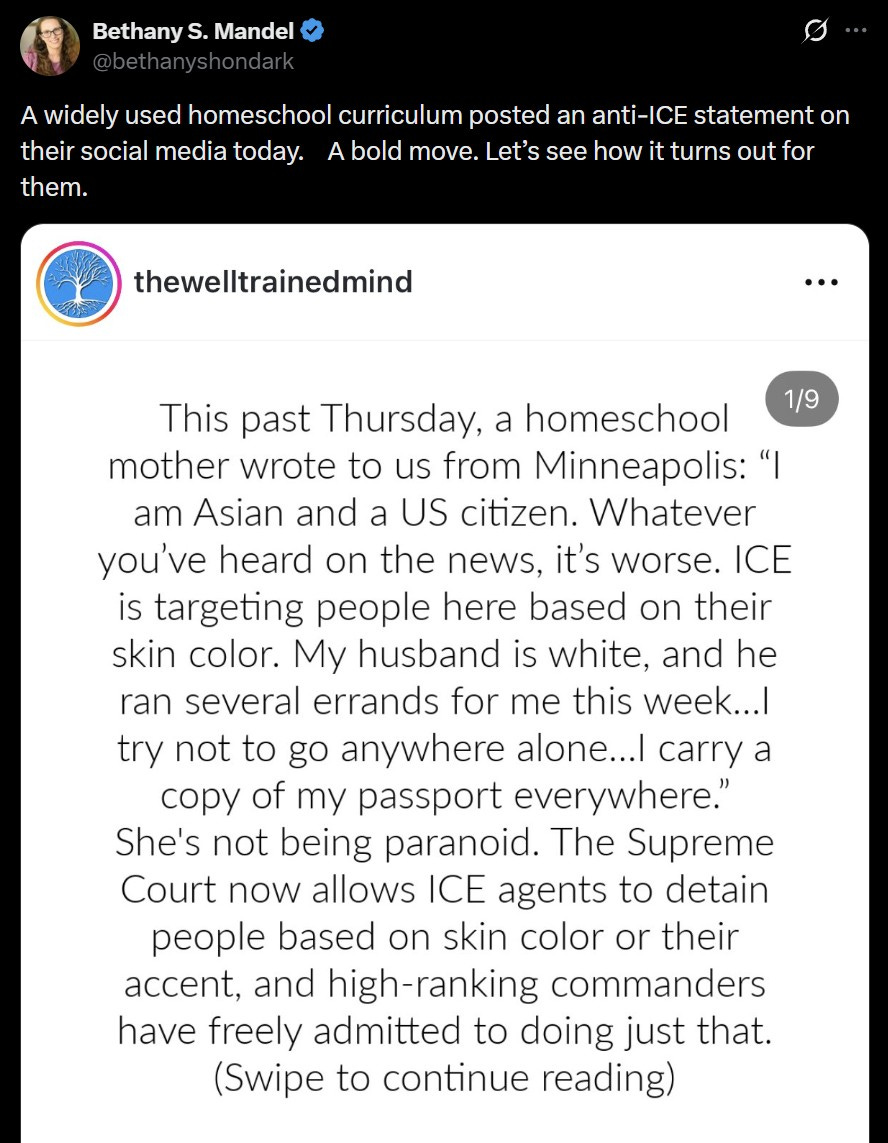
If you don’t know much about “curriculum wars” in classical schools and communities, this will sound strange. But strange as it might be, educators, parents, and more are fiercely devoted to the producers of classical curriculum. That’s why Susan Wise Bauer’s recent activity on X (and elsewhere) has been something of a shock for many. Since Classical Education practitioners are hyper-committed to their curriculum of choice, SWB’s comments caused something of cognitive dissonance for many (though there were plenty of “I said this X years ago” to go around). But I’d wager this will actually become a larger Cultural-Political argument within CE, with the curriculum’s content becoming almost irrelevant. More and more teachers, parents, etc. will allow current political views to override the fundamental position of a Classical Education, namely that the reading of old books, following the old paths, is the most important aspect of learning. The curriculum that says “the right thing” in the “right now” will be the texts that schools and co-ops turn to for structure. And I don’t think is a good thing.
This issue has always existed, though somewhat below the surface. I’ve spoken with teachers who will deride modern fiction in one breath and then hand out essays by Howard Zinn or David Barton to guide their history discussions, without even the slightest sense that this might be contradictory. That’s because History is one place where Presentism has always been tolerated in the Classical classroom. I imagine this will be put to the test in 2026, with Presentism getting worse.

2. The “100-year” benchmark will be tested in the classroom.
The century-long waiting period for bringing works into a permanent place of significance in a Classical Education has always been a contested one. This has tended to be a discussion larger than mere politics though. A few years back, Josh Gibbs put together an interesting essay on how to think about the hundred-year rule, and the Circe Institute let Adam Andrews offer an equally thought-provoking rebuttal. These two theses represent the general tone that people take on when discussing what makes something worth reading, though as I’ve said there tend to be exceptions (aside from History, Science and Math sometimes get a free pass on this note in schools as well). But some of the books that people have argued should be avoided until those works are older are quickly coming into public domain. This year is the 100th anniversary of The Sun Also Rises, for instance. What does such a shift mean for schools deciding which works to assign? The question is an open one.
My concern is that as more books pass the century-mark which have been frequently derided, students and parents will become skeptical of “avoid the present” arguments. I expect to see this debate heat up in 2026, particularly from parents and students who were encouraged to take a “wait-and-see” approach to modern literature. There is also the possibility that more and more students will take the “Great Books Is for Losers” approach, which I think it hyperbolic and riddled with logical problems.1 I hope it will have the positive side effect of giving educators pause before declaring a book will never be remembered 100 years from now. But I think rather we’ll see schools start to entertain more modern books and translations, which will only continue the partisan divide.
3. The teacher shortage problem will show signs of waning.
I used to hear the following phrase often: “classical teachers don’t grow on trees.” The idea holds multiple connotations. It might mean teacher training programs were suspect, suggesting that hires with those degrees have to be “untrained.” It might mean that teachers who know the tradition lacked that necessary “something” for the classroom. Either way, the sentiment is losing steam. I think one of the most exciting shifts in the CE world over the last few years has been the growth of training programs. Here are just a few of note:
The CiRCE Institute’s apprenticeship program (with some great stuff from Carrie Eben)
Thales College’s Certificate in Classical Education Philosophy (a program that I teach in, along with Mandi Gerth, Josh Herring, and Bryant K. Owens)
The University of Dallas’s Classical Education program (who are blessed to have Paul Weinhold with them)
Hillsdale College’s Classical Education program and master’s degree
And those are just the ones already underway. Ohio State’s Chase Center and FSU’s Institute for Governance & Civics will be adding Classical Education items to their programs in the coming years.
I genuinely believe that the problem of lacking teachers who know the Tradition and are capable of teaching it is coming to an end. It might still take a couple of years to fully resolve, but I imagine 2026 will be the year where the tide turns in a favorable direction.
4. A.I. will make its way into the Classical Classroom.
Obviously, A.I. is on most people’s minds. And I cannot recommend enough that you pick up the most recent issue of Classis Journal, which was dedicated to thinking about Classical Education and artificial technology (you can read a couple of the essays digitally). Almost a year ago, I published my thoughts on A.I. and education, and I think that post remains a nice summary of my views. But while I tended to view this largely as a progressive problem, I’ve grown concerned that folks with a more conservative view are likely to cave on artificial intelligence rather soon. The common perception that conservative people are slow to adopt new things only holds true in a limited degree. It’s like the old “hunters are bad” argument, which fails to recognize that “hunters” are also the staunchest conservationists. Conservatives are wary of new things, rightly so, but they also become swift adopters if something wins them over. And I am very concerned that too many conservatives are becoming persuaded by artificial intelligence.
Primarily, I worry we will soon see classical schools accept work from students that utilizes A.I., probably initially in a policy change that appeases parents. But it will get worse. Administrators will start managing teachers and discipline using A.I. Teachers will use A.I. in their grading. And all of this will lead to a lessened education. I’m no Luddite, though some will interpret my resistance to A.I. in those terms. I simply think the same thing I thought when iPads were being given to students, when schools were experimenting with “smart phone courses.” Namely, I think that education is best facilitated between people, real-flesh-and-blood people. And the more A.I. becomes the casual tool of Classical Education parents, students, teachers, and faculty, the harder it will be to keep its corrupting influence out of the classroom. It reminds me of Cotton Mather’s famous dictum: “Religion brought forth Prosperity, and the daughter destroyed the mother.” I think 2026 will be a determining time for how CE handles A.I. I just hope it turns the right direction.
These are undefended claims. I’ve not linked a bunch of data points, nor delved too deeply into anecdotal evidence which led me towards these conclusions. And I could be completely wrong on every one of them. Of course, I don’t think that will be the case. Maybe I’ll revisit these ideas in January 2027 and see where things stand? But until then, I’d encourage those interested to keep an eye out.

Thanks for the shout out, Sean! Miss having you around the area and working on conferences with you. And, your children and wife are delightful!
Sharp insight on curriculum wars getting political. Seeing texts chosen for "saying the right thing now" rather than old paths shows how fast presentism creeps in. I saw this at a homescool co-op where parents wanted Howard Zinn for history but rejected modern literature, total contradiction. The hundred-year rule being tested with books like The Sun Also Rises will be fascinating to watch.